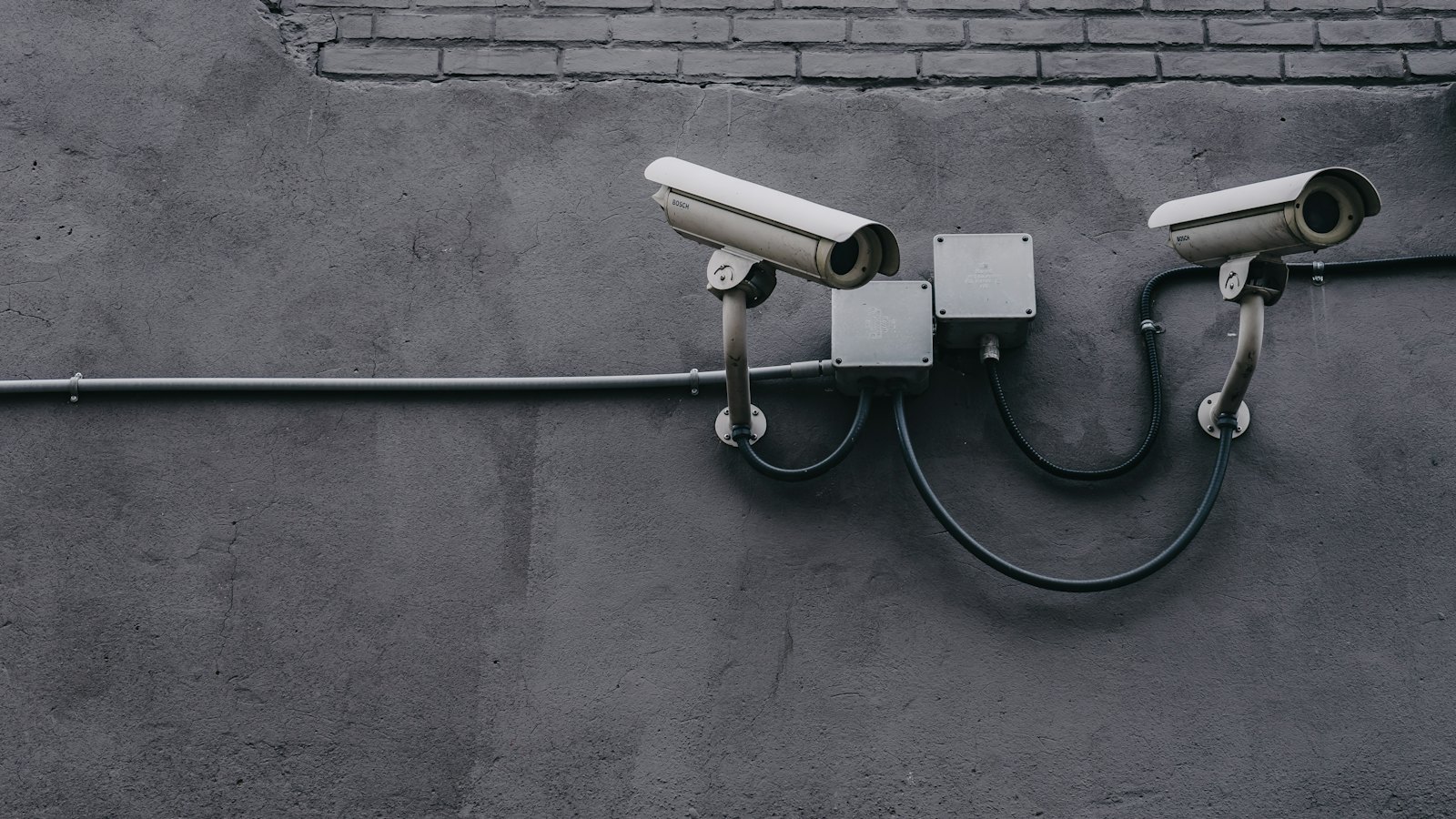
IP Video Surveillance
Security Cameras
Camera systems designed around what you actually need to see: faces at the door, plates at the gate, and analytics that surface the event instead of burying it.
Overview
Coverage you can prove, footage you can use
Most failed camera systems fail the same way: enough cameras, wrong placement. A wide shot of a parking lot tells you a person was there. It does not tell you who. Pixels-per-foot, lens choice, mounting height and lighting decide whether footage is evidence or just video.
We start with a threat and coverage review covering entrances, cash handling, docks, stock rooms, perimeter and blind corners, then design each camera to a target identification standard and model the field of view before a single bracket goes up.
Systems are built on open, non-proprietary IP platforms so you keep the choice of who services them. We deploy on-premise NVR, hybrid, and cloud-managed architectures depending on your bandwidth, retention needs and how many sites you have to watch at once.

Where we deploy it
- Retail loss prevention
- Warehouse & dock
- Multi-family communities
- Schools & campuses
- Car lots & yards
- Healthcare
- Construction sites
- Municipal facilities
Talk to an estimator
Send us drawings, a device count, or just the square footage, and we’ll tell you what the scope realistically looks like.
Capabilities
What this service actually includes.
Not a category heading, but the specific work we self-perform under it.
Camera design & selection
Fixed dome, bullet, multi-sensor panoramic, PTZ, fisheye, thermal and license plate recognition cameras, each chosen for the scene, the light and the identification target it has to hit.
AI video analytics
Person and vehicle classification, line crossing, intrusion zones, loitering, object left behind, crowd density and appearance search, so an operator reviews the ten clips that matter, not ten hours.
Recording & retention
NVR, server-based VMS and cloud or hybrid recording sized to your required retention window, with RAID protection, failover recording and bandwidth-aware stream profiles.
Remote & multi-site viewing
Secure mobile and desktop access, health monitoring that tells you when a camera drops offline, and unified multi-site views for regional and national portfolios.
Analog to IP migration
Reuse existing coax with HD-over-coax encoders where rip-and-replace is not practical, then phase in full IP as budget allows, keeping you recording throughout the transition.
Low-light & harsh environments
IR and white-light illumination, true WDR for backlit entries, IP66/IK10 vandal-rated housings, and heated enclosures for exterior, freezer and industrial placements.
On site
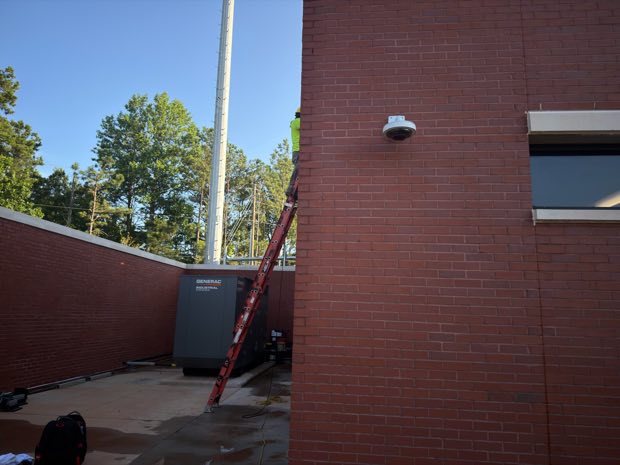
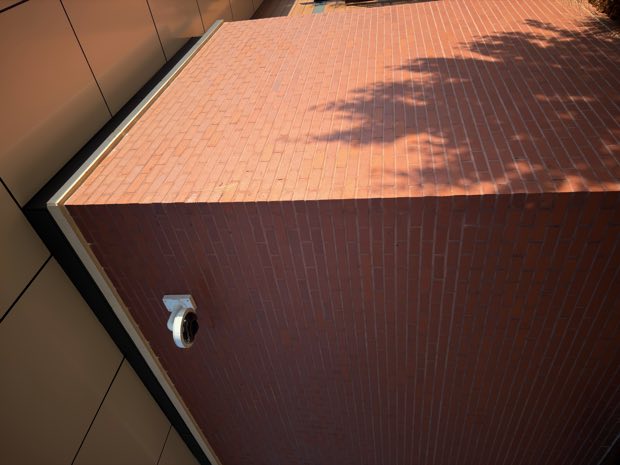
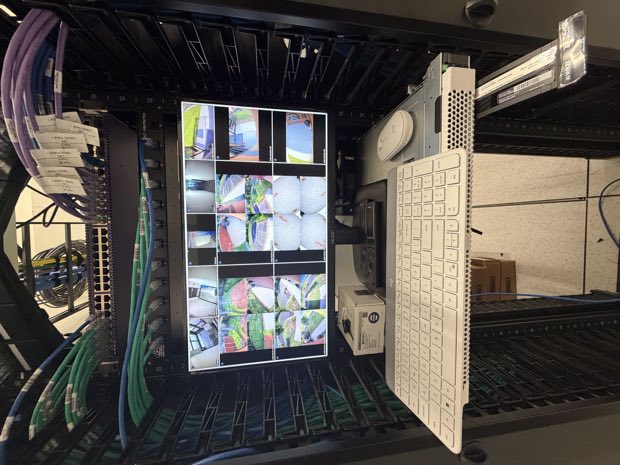
Our own work, photographed.
Not stock imagery. These are Wiscom installations.
Specification
How we decide what to specify.
The reference table our estimators and engineers work from when scoping this service.
| Objective | Pixels per foot | What you get | Typical placement |
|---|---|---|---|
| Monitor | ~20 PPF | Activity and movement in an area | Open parking, yard overview, general floor |
| Detect | ~30 PPF | A person is present and what they are doing | Aisles, corridors, loading areas |
| Recognize | ~50 PPF | Recognize someone you already know | Lobbies, back-of-house, stock rooms |
| Identify | ~80 PPF | Court-usable identification of a stranger | Entry doors, POS, cash office, teller line |
| LPR | ~100 PPF on plate | Reliable plate capture and read | Gates, drive lanes, exit chokepoints |
Close-out
What you receive when we’re done.
Documentation is part of the scope, not a favor. Every security cameras project closes out with the same package, so the next person to touch the system, whether that is us or somebody else, can work from facts.
- Camera plan with field-of-view and PPF per device
- Retention calculation and storage sizing worksheet
- Commissioned analytics rules tuned to reduce false alerts
- Admin and operator training with recorded walkthrough
- Credential handover with documented, non-default passwords
- Health-monitoring setup so offline cameras raise an alert
FAQ
Security Cameras: common questions
Thirty days is the common commercial default, and many insurers and franchise agreements specify it. Cannabis, gaming, banking and some healthcare settings are held to longer statutory windows. Retention drives storage cost more than anything else, so we size it deliberately rather than guessing.
On-premise gives you the lowest ongoing cost and no upload bandwidth burden. Cloud gives you offsite resilience, simple multi-site management and no server to maintain. Hybrid, meaning record locally and push events and clips to cloud, is what we recommend for most multi-location clients.
Substantially. Classic motion detection fires on rain, headlights, shadows and blowing trash. Deep-learning classification only alerts on an actual person or vehicle, which is the difference between an alert stream people watch and one they mute.
Usually yes. We audit what is there, document the gaps, and tell you plainly what is worth keeping and what is not. Open-platform systems are straightforward to adopt; genuinely closed proprietary systems sometimes are not, and we will say so.
Related
Pairs well with
These disciplines share pathways, power and closets. Bundling them saves a mobilization.
Free estimate · No obligation
Let’s scope your project.
Tell us what the building has to do. We’ll walk the site, design the system around it and give you a written estimate with no line items you can’t explain.
- Site survey before we quote, not after
- Written scope so you can compare bids honestly
- One accountable contractor across every low voltage trade
Mon–Fri 9:00am–5:00pm ET · HQ in Doraville, GA · Crews nationwide